Joana Galego: Os Dias Mais Curtos

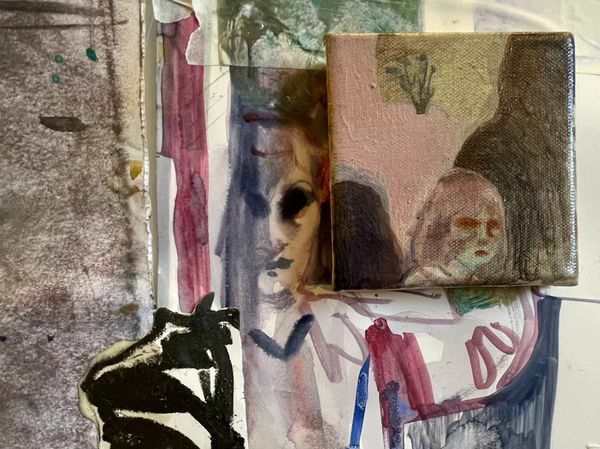
On December 22, 2025, Joana Galego arrived at Galeria Belard with a suitcase containing hundreds of drawings. During the shortest days of the year, the London-based Portuguese artist transformed the gallery into both studio and exhibition, allowing the work to unfold publicly over time. On January 8, 2026, Os Dias Mais Curtos was revealed as an immersive, site-specific, larger-than-life collage—functioning not only as a backdrop, but as an extension of the artist’s paintings.
Over the past three years, Galeria Belard has questioned how Contemporary Art is encountered, approaching each exhibition as an experiment in proximity and engagement rather than passive viewing.
Within this context, the gallery invited London-based Portuguese artist Joana Galego to use the exhibition space as her working studio during a period associated with return and interiority. Between 22 December 2025 and 8 January 2026, the shortest days of the year, the gallery remained open while Galego worked daily, cutting, repositioning, and layering hundreds of drawings across the walls and ceiling until the architecture itself became an installation.
Drawn from the artist's personal archive, the installation brings together hundreds of drawings produced across different moments of her life and practice. Past and present coexist within a field structured through adjacency rather than hierarchy. Paintings appear within this environment not as separate works but as moments of resolution, embedded within the same processes of selection and recombination that follow an entropic rather than linear logic. Here, drawing functions not as preparation but as thinking itself, a process expanded architecturally to reveal what is compressed within the canvas. Sleeping figures, mountains, bodies of water, and dispersed presences appear, dissolve, and re-form across the space. Past moments fold into a new image that remains open and unstable.
The title refers to a period when light contracts and attention turns inward. Conceived during a time marked by uncertainty and saturation, the installation proposes making as a space where impulse can lead. For the artist, this is withdrawal into process, an interior state where thought reveals itself through the hand. For those who enter the space, something else emerges: an encounter with scale. Mountains repeat. Water expands. The body sleeps while nature persists. The installation doesn't console. It locates us, small and awake, within something vast.
The installation offers no central image and no fixed viewpoint. Instead, it invites a slower form of engagement: to move through the space, to look laterally, and to allow meaning to emerge through patience, proximity, and duration.